How is a door actually made? There is a large selection of residential and room doors. But what does the path from the idea and product development to production in the factory and the interior door ready for delivery look like? Our "Door in dialogue" tells the story of how it all came about. We received help from Marbod Gerstenhauer, division manager for door production at GARANT.

What is a door?
Mister Gerstenhauer, we start with an almost philosophical question: What is a door?
Marbod Gerstenhauer (MG): A door is a lockable passage to a building or through a building opening. Its basic structure is simple: the frame and bolt form the door frame. The insert and panel of the door, the so-called "ceiling", cover the bolt and frame. So much for the lowest common denominator.
But a door consists of up to 40 parts, which open up hundreds of possible combinations. This also includes lacquers, cramps and adhesives, fittings, a variety of locksmiths, as well as spies, vent-grates for wet rooms and bathrooms and much more.
Which machines do you use in door production?
MG: There are presses, formatting systems, surface machines, painting, drill bit and milling lines and - also important - so-called "Easypickers". These assembly assistants take the strain off the employees. Thanks to the "Easypicker", the door floats freely and securely in front of him. This means that no one has to support anything heavy or put unilateral physical strain on themselves.
High door quality: You can't do it without qualified employees!
And what role do people play in production?
MG: It wouldn't work without our qualified employees!
On the one hand, door production is a highly automated process. On the other hand, our employees monitor whether the interlinked work processes run smoothly. They also fill the magazines with the right raw materials. That's why we have three employees per machine: one fills, a second monitors. Finally, a third person takes the door out of production and checks the quality criteria. He then forwards it to the next production step via roller conveyors.
Then there are our machine or CNC system operators: they work on complex, CNC-controlled machines. Therefore, these employees must all be equally highly qualified. It must always be ensured that the machines run smoothly. A system that stands still costs us a lot of money.
How many production steps are there?
MG: We basically have two production results with up to twelve steps. Firstly, there is the standard door. They are produced in large quantities using highly standardised processes. A lot of it runs automatically.
On the other hand, we have the construction or customised door: these are doors that are manufactured individually according to personal requirements, in small quantities. They often have special functions such as sound insulation or fire protection. Manual labour plays a very important role with these doors. This means that production is more complex than for standard doors.
Incidentally, the trend is towards construction doors: of the 3,000 or so doors that we press in the factory every day, 450 are customised doors.


And so a door is created:
Step 1: First, the material goes through the presses. Only after the raw materials have been pressed do we talk about the door or the door blank ("off the press").
Step 2: Now the door blank goes through the so-called "formatting" process. Up to this point, it does not yet have a format. The transoms and decks are still slightly larger than the final dimensions so that they can be worked on.
Step 3: Now we define the edge geometry. Will this door have a square or round edge? The thicker the door, the more it absorbs sound. (However, several door elements work together for good sound insulation. The thickness is not the only decisive factor).
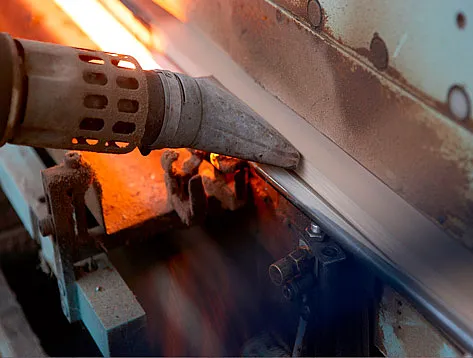
Step 4: Doors with CPL (a type of melamine) undergo "postforming". This creates a seamless edge coating. This is not only particularly stable, but also popular with customers for its beautiful, smooth appearance.
Step 5: Lacquered doors now go to the "design processing centre". This is where they receive their decorative milling or decorative joints, for example.
Step 6: The lacquered door then moves to the lacquer line. It is given a water-based primer, i.e. solvent-free. Once the final coat has been applied, it is then cured with UV radiation. The door is now robust enough for stacking and further processing.

Step 7: Particularly sophisticated designs are sent to the "specialist": The spray robot finishes doors with profiling, design joints and special surfaces.
Step 8: The door is drilled.
9th step: for "special doors", such as construction and functional doors: locks, glazing, hinges, peepholes and door closers are fitted at the top and inside during door assembly. Here, an employee signs a test report for each individual fire door, for example. This means that he is personally responsible for the quality of this door.
Step 10: Final assembly:
- The standardised door now goes into automated final assembly. "Colleague Robot" attaches hinges and locks, for example.
- The special door has special functions such as fire protection or, in some cases, elaborate style elements. That's why it goes to the manual workstations in final assembly. Five employees work here per shift. They insert special glass elements, apply decorative mouldings and fit special fittings.
Step 11: There is an additional inspection workstation for certain sample and test doors. The shift supervisor takes a close look at each of these doors individually. He then stamps the underside of the door to certify that everything has been checked and is in order. This is our workstation 0082 - "on a special door mission", so to speak.
Step 12: Finally, everything is packed semi-automatically - and off it goes to the warehouse.
Certificate for quality doors
Anyone who buys a fire door receives it with their own test certificate and personal signature. "It's all about safety, that's the top priority," says Marbod Gerstenhauer.
Naturally beautiful
The NT-LA10-DA pivot door impresses with its authentic CePaL surface in cracked oak and brings natural warmth into any room. In combination with the SATINATO glass, it creates a harmonious interplay of wood texture and translucency. Stylishly complemented by the MONO fitting set in matt stainless steel - for timeless design and long-lasting quality.

Elegance in matt - FeelJade
With its elegant G-TEC FeelJade surface in a beamless finish, the NT-DA single door embodies modern living aesthetics. The graphite black fittings and the MONO smart2lock system ensure a harmonious overall look with smart functionality. Perfect for anyone who wants to combine design, convenience and technology in one door.
